


An international conference that brought together science, art and artificial intelligence

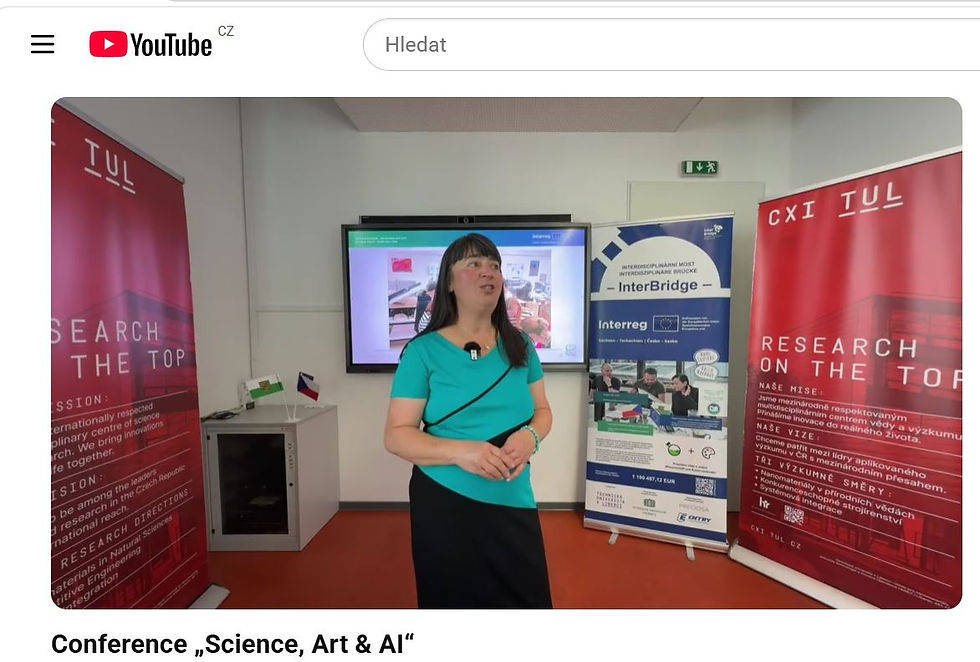
What do soap bubbles, artificial intelligence, fractals, the emotional map of the Jizera Mountains, fashion design and medieval gallnut ink have in common? The search for similar connections was the main topic of the international conference Science, Art & AI, which took place on May 18th at the CXI (Technical University in Liberec) as part of the Czech-Saxon InterBridge project.
When the InterBridge project was being prepared a few years ago, no one had any idea how quickly artificial intelligence would become a part of everyday life. However, during the project, AI gradually penetrated not only into research, but also into exhibitions, workshops, work with children or design object designs. The conference was thus a natural outcome of many activities that were brought about during the cooperation between the Technical University of Liberec and the Technical University of Chemnitz.
It was clear to us in advance that this would not be an ordinary professional conference. The program offered almost twenty contributions by lecturers from the Czech Republic, Germany, Turkey and other countries. In addition to classic lectures, there were also contributions using artificial intelligence, pre-recorded presentations with digital avatars and views on current technologies from the perspective of scientists, artists and designers. Some participants came in person, others joined online or sent a pre-recorded contribution, while some presentations used digital avatars created using artificial intelligence tools.
The diverse composition of lectures showed how broad the connection between science, art and modern technologies can be. Participants were able to learn, for example, about the use of artificial intelligence and mixed reality in textile teaching, the potential of 3D printing for smart textiles, the creation of colors using plasma technologies, the mathematical beauty of fractals, the relationship between artificial intelligence and artistic creation or the issues of authorship and creativity in the age of generative AI. There were also contributions dedicated to design, architecture, landscape, material research and the use of recycled materials in artistic practice.
The diversity of topics confirmed one of the main ideas of the InterBridge project – that inspiration often arises at the borders of individual disciplines. Although at first glance it may seem that scientists, engineers, artists and designers work in completely different worlds, during the discussions it was repeatedly shown that they are united by curiosity, experimentation and the search for new paths. The conference also offered an opportunity to look back on more than two years of cooperation between the InterBridge project partners and the many activities that emerged during the project.
We have already sent certificates to all participants. We are currently completing an electronic collection of extended abstracts with ISBN, which will be freely available to the public after publication. At the same time, the recording of the conference is being processed, which will be published on the InterBridge project YouTube channel and supplemented with Czech and German subtitles.
We would like to thank all speakers, participants, students and members of the organizational team for creating an inspiring atmosphere and for the many interesting discussions that arose during the conference. Although the InterBridge project is slowly approaching its conclusion, we believe that the contacts, friendships, experiences, and new ideas that emerged during it will continue in other joint activities.
Hana Křížová


Comments