


Looking back at the second group exhibition of the InterBridge project


In the first half of December (December 4 - December 19, 2025), we organized the second large group exhibition of the InterBridge project at the university's Gallery N in Jablonec nad Nisou. This time, exceptionally, in a joint dialogue with the Department of Design of the Faculty of Textiles of the TUL, which presented student collections focused on sustainable and ecological fashion on the same date. The result was a space where clothing, technology, experiments and people's stories naturally met.
The lower floor of the gallery belonged to capsule clothing, eco-fashion and student collections created as part of a project supported by the Technology Agency of the Czech Republic. They were smoothly followed by the InterBridge project exhibition on the upper floor, which summarized the year-long Czech-German cooperation - from clothes and accessories created for this year's fashion show in Prague to creations created within the framework of workshops, residencies, excursions, experimental work and work with children. Which of the two exhibitions was more significant is absolutely clear, because both exhibitions were held under the title "InterBridge - the connection of science, technology and art" .... 😊
The opening of the exhibition took place on December 4 in the early evening and attracted several dozen visitors - mainly students, teachers and their loved ones. We also wrote about the opening in the Liberecký deník and you can see this article here.
We opened the exhibition together with the head of the Department of Design, Dr. Jana Drašarová, who presented the student work and the concept of connecting traditional textile techniques with new technologies. For the InterBridge project, I then followed up with a brief reflection on how cooperation, sharing and joint search create relationships that go far beyond a single project. Yes, there was a bit of pathos in that – but for a project that has “bridge” right in its name, it simply couldn’t be avoided.
The atmosphere of the opening was complemented by small refreshments. The catering, ordered from a catering company from Jablonec so that we could minimize our carbon footprint in the spirit of the co-exhibited environmentally sustainable fashion, did make a small circuit through the entire Liberec region due to a logistical oversight and the original intention somewhat missed the mark, but the main thing was that in the end the refreshments arrived on time and the visitors enjoyed themselves. And so, debates about fashion, technologies, materials and cooperation between Czechs and Saxons took place over the exhibits, during which visitors refreshed themselves not only with mini sandwiches and desserts, but also with good wine.
As already mentioned, the exhibition had two main parts, which were not separate, but seamlessly intertwined. The eco-fashion on the ground floor was seamlessly connected to the outfits combining textiles and 3D printing, which were created throughout the year in preparation for Mercedes-Benz Prague Fashion Week and some of which we actually saw at the summer fashion show. There were Lada Mačková's imaginative handbags, and there was also the legendary luminous maximum shell of the Ostranka, which was part of the model designed by Tamara Koritárová in the MBPFW collection. The exhibition was installed by our art methodologists Jan Rouha and Lukáš Dostálek from the Faculty of Art and Architecture of the TUL. The exhibition also included their own work Permanently Not/Finished - reliefs and objects reflecting the pressure for perfection, the speed of the digital age and the conscious leaving of things open. They contained the message that the process is often more important than the finished result.
Next to them was Jakub Janďura's installation „The Weight Test“, based on a seemingly banal physical principle: a loosely placed rubber band forming under its own weight into an organic, each time different shape. Physics, space, material and interpretation in one – an open work that changes depending on the place, context and the viewer’s perspective. How do I know all this? Well, because I’m not exactly a fan of modern art and I thoughtlessly said that “we have this in the garage too”. I did not escape punishment for my bluntness – our art methodologist Lukáš subsequently gave me a very focused lecture on antiform, the relationship of material to space, openness of interpretation and the importance of process over result. From that moment on, I will look at every rubber band with much more respect…. 😊
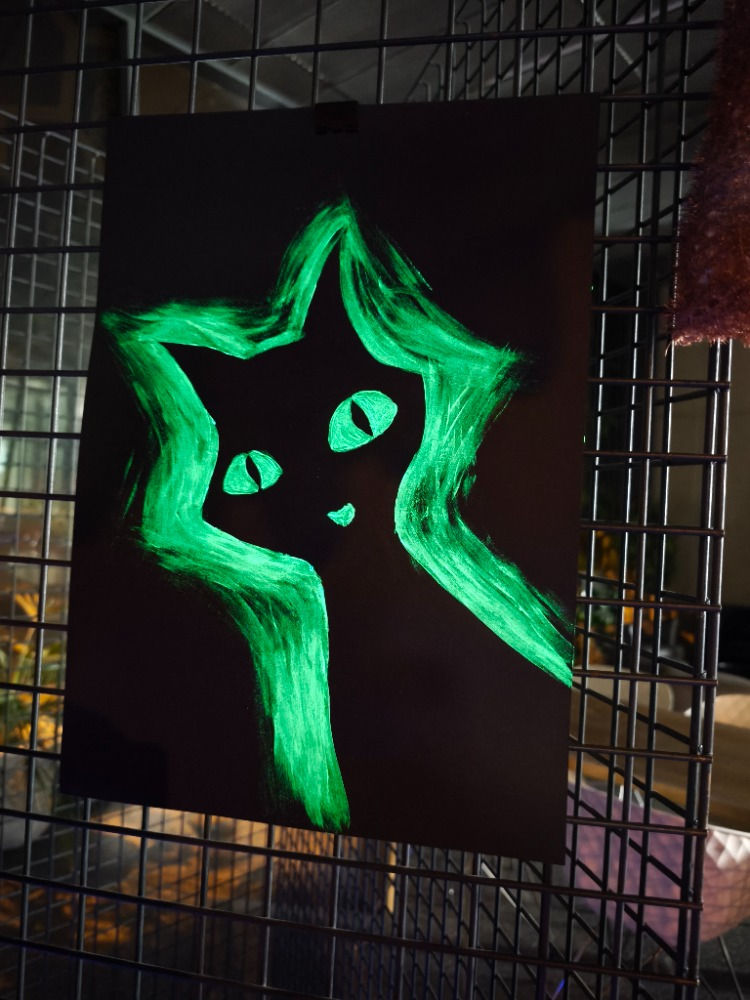
Part of our group exhibition was also a collection of T-shirts with luminous (phosphorescent) prints, which Lukáš Prokop created in collaboration with AI and our German partners and which we exhibited this summer behind the glass wall of CXI. This time, however, the T-shirts were not physically exhibited – the UV lamps required to illuminate them would not be very friendly to the eyes of visitors. The solution was a photo series that FUA student Richard Králiček took of a male and female model from FT TUL. The resulting images were shown on a large screen and were among the places where people stopped the longest.
An important part of the exhibition was also the work of children from the Czech-Saxon border region – from the U Lesa Elementary School in Nový Bor, the Sokolovská Elementary School in Liberec and the Chr. Weise High School in Zittau. Their work – cardboard figures decorated with glass chatons in dynamic poses, jewellery and decorations made from beads that the children received from Preciosa during excursions in Desná and Kamenický Šenov, objects made from 3D pens created during a workshop at CXI – was presented in a combination of physical installations and photographic loops on both large screens in the corners of the upper floor of the gallery. Children from all three participating schools actually came to see the exhibition – exactly as we had promised them during their excursions to Preciosa a year ago. They saw their products in a gallery context – and that was the moment when InterBridge worked the most. I will return to these visits in more detail in a separate article dedicated to two joint excursions by Czech and German pupils in December.
The second group exhibition of the InterBridge project at Gallery N was a look back at a year of intensive collaboration between individuals, schools, universities and institutions from Liberec, Zittau, Nový Bor and Chemnitz – and at the same time a confirmation that the connection of science, technology and art makes sense not only on paper, but mainly between people.
Hana Křížová


Comments